

Differences Between Common Curing Methods for Silicone Sealing Materials
In electronics & electrical, precision equipment, automotive parts, industrial control equipment and semiconductor processing scenarios, silicone sealing materials are widely used — covering waterproof sealing, insulation protection, gap filling and cushioning, and weatherproofing. Many customers, when selecting materials, focus only on finished performance such as temperature resistance, insulation and waterproofing, while easily overlooking the most critical matching prerequisite — the curing method.
In fact, the curing method directly determines a material's working conditions, production efficiency, suitable substrates, molding results and long-term service life. If the curing method mismatches the production line process, production environment or equipment conditions, even the best performance parameters cannot prevent problems such as poor surface drying, uncured interiors, adhesive cracking, bond detachment, substrate corrosion and low production efficiency.
Based in Shanghai and specializing in high-end industrial materials, XIFUTE has long focused on the selection, supply and technical service of silicone chemicals, adhesives and specialty chemicals, serving numerous R&D and mass-production manufacturers. Drawing on extensive on-site sampling and application experience, we break down the principles, pros and cons, and suitable scenarios of the industry's four most common silicone curing methods — room-temperature moisture curing, heat curing, UV curing and two-component mixing curing — helping companies select precisely, match their production lines and reduce trial-and-error losses.
1. Room-Temperature Moisture Curing: For Small Batches and On-Site Work, No Equipment Required
Room-temperature moisture curing is the most mainstream curing method for one-component silicone sealing materials. It relies on trace moisture in the air to trigger the crosslinking reaction, curing naturally at ambient temperature — no heating, no dedicated curing equipment, and an extremely low operating threshold. After application, the material first skins over quickly, then cures progressively deeper from the surface inward, fitting the vast majority of room-temperature work scenarios.
The advantages of this curing method are clear: easy operation, no extra equipment investment, suitability for on-site repairs, outdoor work and scattered processing steps, plus low storage and usage costs. But the shortcomings are equally evident: curing speed depends entirely on ambient temperature and humidity — the lower they are, the slower the cure, with long deep-cure cycles, making it unsuitable for high-speed mass-production lines. Also, in sealed, airless gap scenarios, moisture cannot penetrate, leaving the interior permanently uncured and effective sealing impossible.
Overall, moisture-curing silicone sealing materials are better suited to equipment maintenance, on-site gap filling, small-batch sampling, custom product processing and outdoor equipment sealing — a common choice for industrial maintenance and small-batch production.
2. Heat Curing: For Mass Production, Uniform and Highly Stable
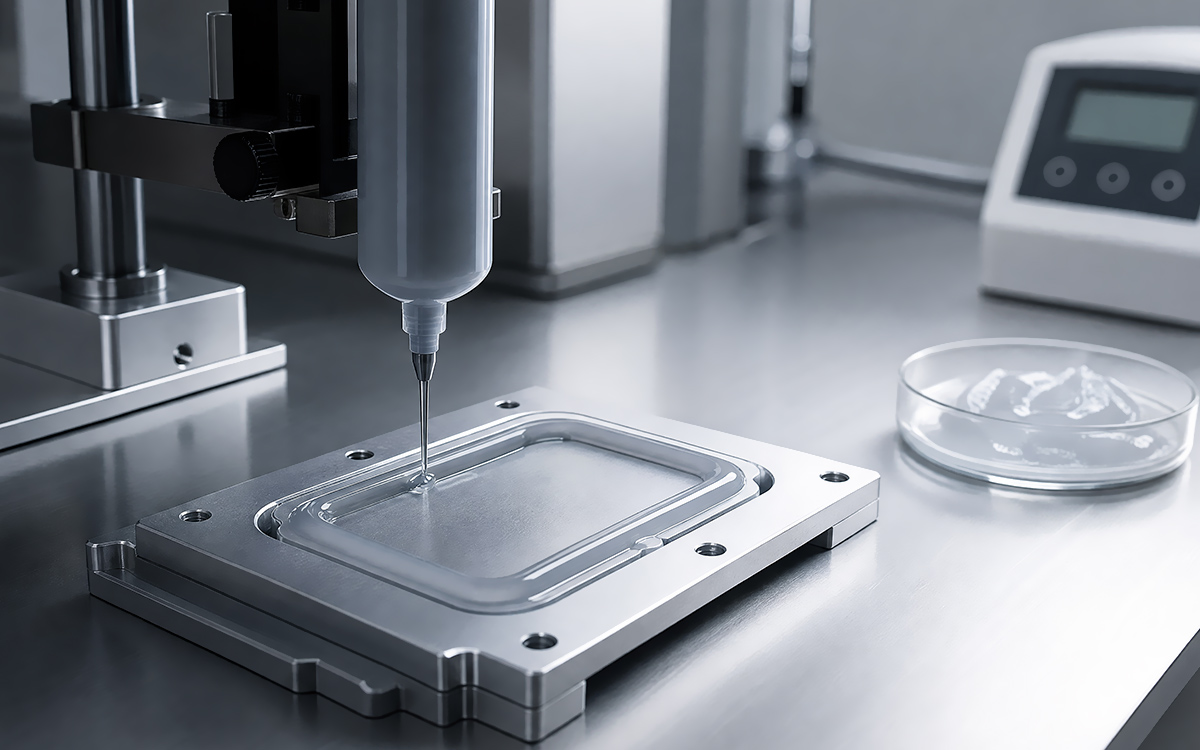
Heat-curing silicone sealing materials are mostly one-component high-temperature systems, relying on a constant high-temperature environment to trigger crosslinking — unrestricted by air humidity or sealed spaces, achieving uniform simultaneous curing throughout, and perfectly solving moisture curing's pain points of uncured depth and slow speed. Common industrial curing temperatures range from 80°C to 180°C, and companies can adjust flexibly based on line equipment conditions and product temperature tolerance.
Its core advantages are fast curing, uniform molding and stable bond strength, unaffected by ambient climate — ideal for standardized, high-volume production lines. The cured material is also denser, with more stable temperature resistance, aging resistance and waterproof sealing performance, suiting mass-production scenarios with high sealing reliability requirements such as precision electronic components, industrial control equipment and automotive electronics.
The only limitation is the need for heating equipment such as ovens or constant-temperature tunnel furnaces, and some heat-sensitive plastics and thin precision substrates cannot tolerate it. When serving mass-production customers, XIFUTE precisely matches suitable heat-curing models based on line equipment conditions, substrate temperature tolerance and production rhythm — avoiding substrate deformation and curing defects, and ensuring uniform batch production quality.
3. UV Curing: Ultra-Fast Curing for High-Precision, High-Efficiency Processes
UV-curing silicones have become mainstream materials in high-end precision manufacturing in recent years, curing instantly under ultraviolet light — surface and deep curing completed within seconds, the most efficient of all curing methods. This method needs no high temperature, no waiting and is unaffected by temperature and humidity, greatly compressing production cycles and fitting high-speed automated lines.
UV-cured silicone sealing materials offer high transparency, dense texture, no bubbles or deformation, and excellent insulation, moisture resistance and aging resistance — especially suitable for lens sealing, precision component protection, bonding and sealing of light-transmitting parts, and ultra-thin precision product processes. But it has one core weakness: shadowed areas and gap bottoms that light cannot reach will not cure. For deep gaps, shielded structures and multi-layer bonding scenarios, UV curing alone cannot meet requirements — some scenarios need a dual-cure system.
4. Two-Component Curing: No Environmental Dependence, for Thick Layers and Sealed Structures
Two-component silicone sealing materials are used by mixing Part A and Part B in a set ratio, curing through chemical reaction between the components — independent of air, moisture, high temperature or light, with the curing process unrestricted by environment or structure. Whether in open scenarios, sealed deep gaps or thick-layer applications, they cure uniformly throughout, with controllable curing speed adjustable through mixing ratio and temperature fine-tuning to match production rhythm.
These materials suit special scenarios such as thick-section potting, deep gap filling and sealed structure sealing. The cured material offers good toughness, low stress and crack resistance, with strong long-term stability — widely used in power modules, circuit board potting and large equipment sealing. The downside is the need for precise mixing ratios and degassing, demanding high process discipline — unsuitable for simple on-site application.
Choosing the Right Curing Method for Your Conditions Is the Core of Efficient Material Use
None of the four curing methods is absolutely better — it is only a matter of scenario fit: choose moisture curing for convenient maintenance, heat curing for stable mass production, UV curing for ultra-fast efficiency, and two-component curing for special sealed structures. Many problems companies encounter — sealing failure, process blockages, low yield — essentially stem from a mismatch between curing method, operating conditions and process.
XIFUTE always centers on customer needs, providing differentiated services for different production models. For R&D customers, we screen silicone materials with suitable curing systems based on product substrate, structural conditions, line capabilities and cleanliness class — defining process boundaries, assisting with sample validation and reducing R&D trial-and-error costs. For manufacturing customers, we prioritize material models matched to mass-production rhythm, ensure batch consistency and stable lead times, provide complete compliance documentation, and optimize production costs and inventory planning.
Going forward, XIFUTE will continue expanding its silicone, specialty sealing and fine chemicals product lines, improving its process adaptation database and technical service system, and deepening its services. Working with upstream and downstream partners, we will build a safe, efficient and sustainable industrial materials ecosystem — helping customers across industries upgrade processes, improve quality and reduce production costs.